PNGi INVESTIGATES
New Ireland logging tycoon linked to corruption, money laundering and abduction
A Malaysian businessman who has been at the centre of the logging industry in New Ireland for the past fifteen years is facing serious allegations of corruption, money laundering and abduction in his home country.
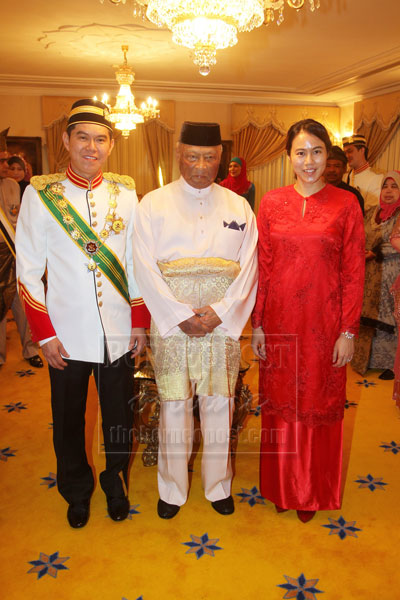
Thomas Hah Tiing Siu (left), Sultan Ahmad Shah and Pamela Ling in 2013. Photo: Borneo Post
Since 2011, companies linked to Thomas Hah Tiing Siu have exported logs valued at more than US$200 million (K800 million) from logging projects on New Ireland and Manus.
The largest of these logging projects, Konoagil, which covers more than one-third of New Ireland, was set up in close association with the local MP, former Forest Minster and now Provincial Governor, Walter Schnaubelt.
Hah’s logging operations are though just one part of his business empire.
Thomas Hah is the founder of the Joinland Group, a Malaysian domiciled company that according to its website has diversified interests in real estate, healthcare, forestry and agriculture spanning Malaysia, Singapore, Australia, New Zealand and China.
In 2013, Hah was awarded the title Dato Sri by the Sultan of Pehang during the sultan’s 82nd birthday celebrations.
However recently Hah’s business operations have come under scrutiny by the authorities in Malaysia.
Earlier this year, the Malaysian Anti-Corruption Commission confirmed that it has been investigating Hah Tiing Siu and his wife Pamela Ling Yueh, for corruption and money laundering offences since May 2023.
This investigation took a more sinister turn in April, when Pamela failed at attend for a scheduled interview at the MACC headquarters in Kuala Lumpur. It later emerged that she had been abducted from her taxi when it was intercepted by men dressed as police officers while she was on route to the interview. Pamela has not been seen or heard from since.
Malaysian police have since arrested Hah in connection with the disappearance of his wife.
Below, we explore the web of PNG registered companies connected to Hah Tiing Siu, his prominent role in the logging industry on New Ireland, the close connections to Governor Walter Schnaubelt and wider allegations of misuse of controversial Forest Clearing Authority logging licences.
We also examine how Hah has used beneficial ownerships to avoid anti-money laundering questions about his operations from commercial banks, detail significant recent changes in the shareholding of his PNG linked companies and expose serious questions about some of the Joinland group’s overseas investments.
The web of PNG companies
Hah Tiing Siu can be linked to 12 companies currently registered in PNG.
Hah was, until February 2024, the holder of 50% of the issued shares in seven of those companies: Islands Forest Limited, Joinland Management (PNG) Limited, Joinland PNG Limited, Mantorras PNG Limited, Millionplus Corporation Limited, Multiplus Corporation Limited and Sukalito Limited.
Through his shareholding in Mantorras Limited and Joinland Management (PNG) Hah is also linked to Tutuman Development Limited and Lulu Developers Limited (where he holds a majority 52% stake).
Other shareholders in Lulu Developers Limited include Hastings Deering (PNG) Limited, the New Testament Church Inc. and former Eastern Highlands Governor, Peti Lafanama.
Hah Tiing Siu is also the holder of 10% of the issued shares in Amanab 56 Timber Investments Limited and was also the owner of an undisclosed number of shares in Manyplus Corporation Limited until 2021 and the owner of an undisclosed number of shares in Maxland PNG until 2018.
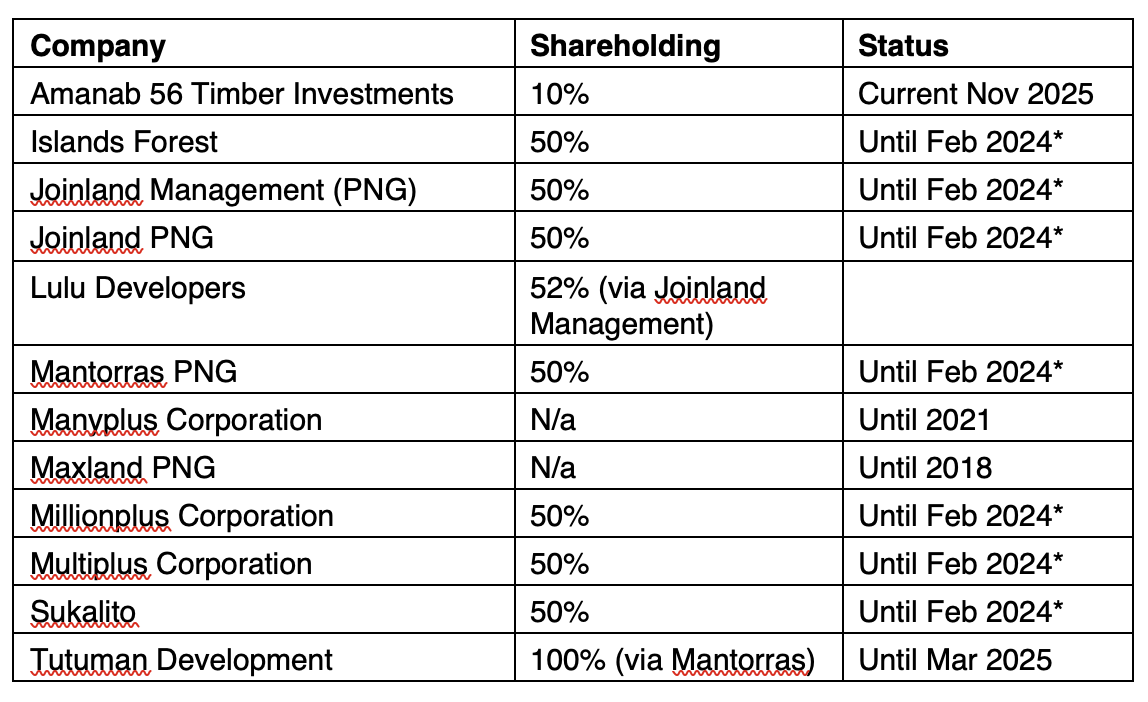
* In Feb 2024, Hah Tiing Siu’s shares in each of these companies were transferred to his co-owner and father-in-law, Kie Yii Ling. These changes are discussed further in Section 5 below.
Hah is also linked to three companies that have been removed from the PNG registry, Joinland Properties (PNG) Limited – removed in 2016 – and Black Coral Limited and South City Developers Limited – both removed in 2023.
Outside PNG, Hah Tiing Siu is the founder of the Malaysian domiciled Joinland Group Limited, a large conglomerate with investments in various countries including PNG, China and Australia.
Although based in Malaysia, the company is registered in the British Virgin Islands.
According to its website, the Joinland Group was founded in 1990 and first ventured into PNG in 2007.
The domination of logging on New Ireland
In the fifteen-year period from 2011, almost half of all logging operations (10 out of 22) on New Ireland have been controlled by companies connected to Hah Tiing Siu and the Joinland Group.
Over that period, these companies have been responsible for 44% of all recorded log exports from the province (2,062,040 cubic metres out of a total of 4,722,433).
Joinland also operated the Pohowa logging project on Manus Island from 2019-22.
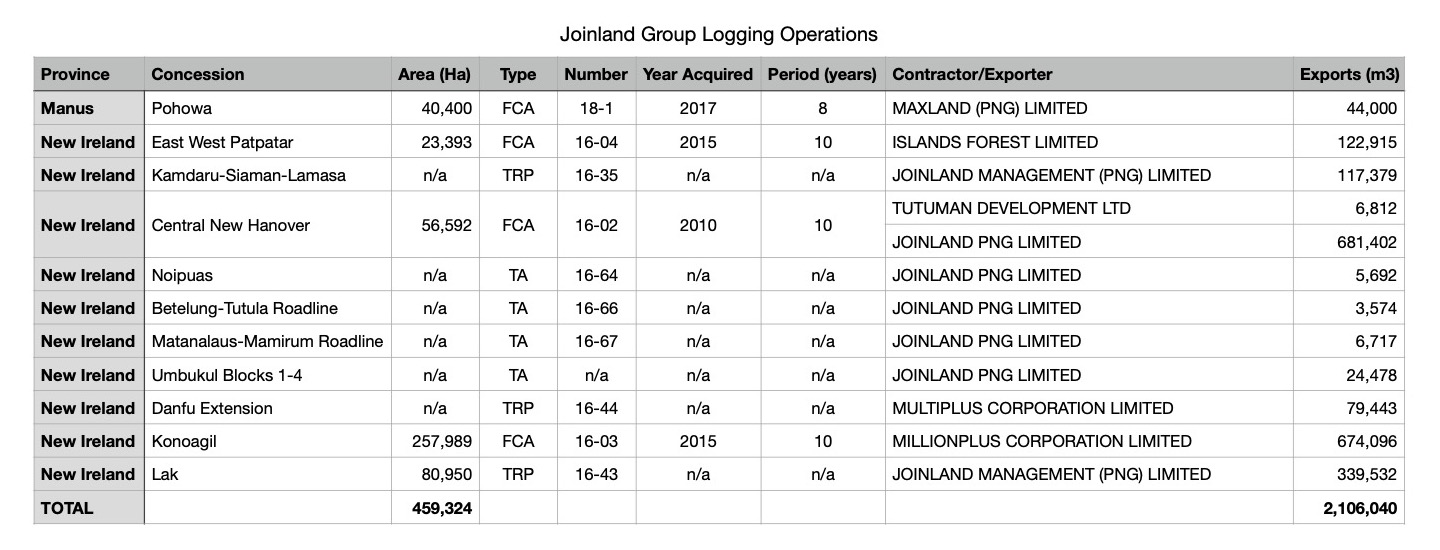
The Joinland Groups total log exports from Papua New Guinea are valued at more than US$200 million in PNG’s official log export data. The true value of the logs could be more than double this figure, if the findings of the UN Office on Drugs and Crime report on transfer pricing are correct.
In a 2025 Global Analysis the UNODC revealed a US$1.5 billion discrepancy in the pricing of log exports from PNG where the values declared in PNG are 50% below that reported when the logs are imported into China.
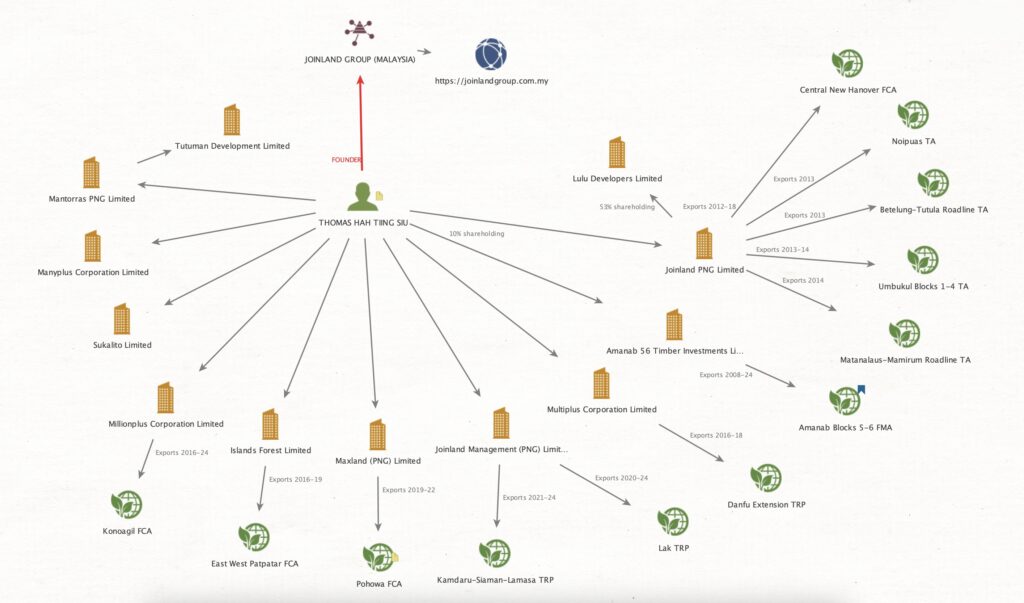
The companies and logging operations in PNG linked to the Thomas Hah and the Joinland Group
The Schnaubelt relationship
Walter Schnaubelt is the Member of Parliament for the Namatanai District in New Ireland and is the current governor of the Province. He was first elected to Parliament in 2017. He served as Minister for Forests from December 2020 until January 2022. After his re-election to Parliament in 2022 he was appointed Minister for Aviation until March 2025 when he relinquished the role to become the Governor of New Ireland.
The Joinland Group’s largest logging operation in New Ireland, by area and export volume, is the Konoagil FCA project. The project is operated by the Millionplus Corporation Limited, which also holds the FCA licence.
According to Australian National University Professor Colin Filer, Schnaubelt was the “brainchild” of the whole project:
‘The scheme was the brainchild of Walter Schnaubelt, a local businessman and martial artist, who made it part of his successful campaign to be elected as the new MP for Namatanai District in 2017. He was described as the ‘spearhead’ in a public forum held to discuss the scheme in the township of Namatanai in 2014.’
[Two Steps Forward, Two Steps Back: The mobilisation of customary land in Papua New Guinea, ANU 2019, page 53]
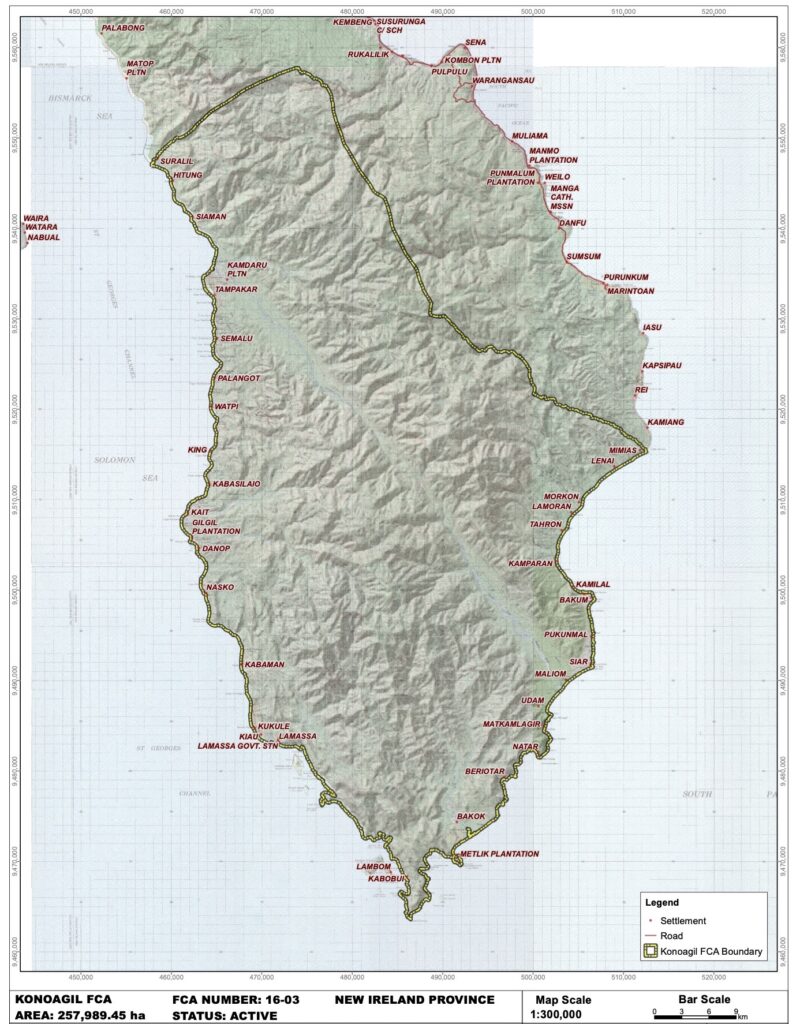
The Konoagil FCA covers a huge area of 257,989 hectares, over one-third of the whole of the island of New Ireland
Filer is very skeptical of the process used to obtain local resource owner consent for the logging.
‘In April 2015, Mr Schnaubelt is reported to have taken 19 local land group chairmen to meet with members of the New Ireland Provincial Forest Management Committee in order to secure its support for the FCA. The FCA was issued in October that year, before any of the new land groups associated with the project had received a recognition notice, and before most of them had even applied for incorporation. It would therefore seem that the National Forest Board did not regard their existence as relevant evidence of landowner consent or participation. Indeed, it is not clear why they have been incorporated at all, since they are not listed as shareholders in either of the two ‘landowner companies’ associated with the project, one of which is owned by the other one, nor do they seem to be represented in either of the two ‘landowner associations’ that are among the three owners of the two companies.’
As Filer notes, some commentators have argued that the whole FCA project is ‘illegal’ because of the absence of genuine landowner consent to what appears to be a partnership between corporate bodies controlled by Mr Schnaubelt and his associates and Millionplus Corporation (PNGexposed 2016, 2017).
Filer also notes that in his defence, ‘Schnaubelt has argued that the project is entirely consistent with the national government’s ‘public-private partnership policy’, and it was up to the provincial government, not the private developers, to secure local landowner support since the provincial government had endorsed the FCA’.
Walter Schnaubelt was at the forefront of negotiations with logging company Millionplus Corporation Limited. At the project launch in April 2016, Schnaubelt urged local people to embrace the initiative: “sapos yu yet laikim dispela project na yu yet sapotim, na yu yet yu kamapim, yu yet by kisim”.
In 2021, the Konoagil FCA project was recorded as the largest log-exporting operation in PNG that year. This is the same year that Schnaubelt was serving as Forest Minster,
Use of controversial FCA logging licences
Some 73% of all log exports from PNG by companies that are part of Thomas Hah’s Joinland Group have come from concessions licensed under the controversial Forest Clearing Authority scheme. Those logs have been valued by the company at more than US$150 million.
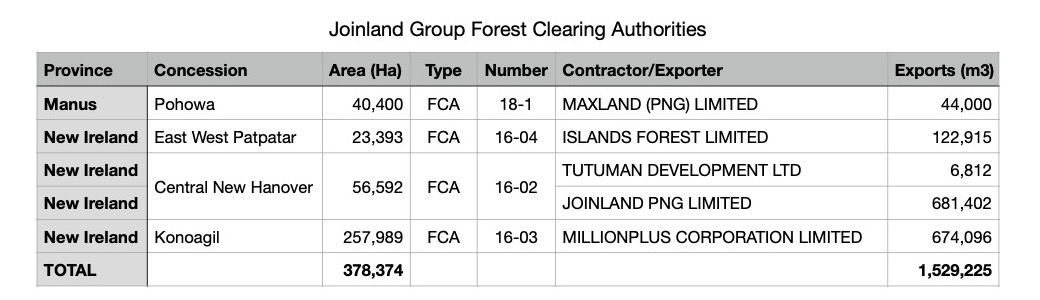
There are numerous reports that have exposed how FCA licences have been routinely abused by logging companies to unlawfully gain access to vast tracts of forest for selective logging.
FCA licences were introduced through amendments to the Forestry Act in 2000.
They are intended to be used to facilitate the conversion of small areas of forest to other land uses, predominantly agriculture or roads.
However, rather than issuing FCA licences to allow the clearing of discrete areas of forest, the PNG Forest Authority has issued licences that cover vast tracts of forests and allowed selective logging, often with no or limited agriculture planting. There is also considerable evidence of unchecked logging outside of FCA boundaries.
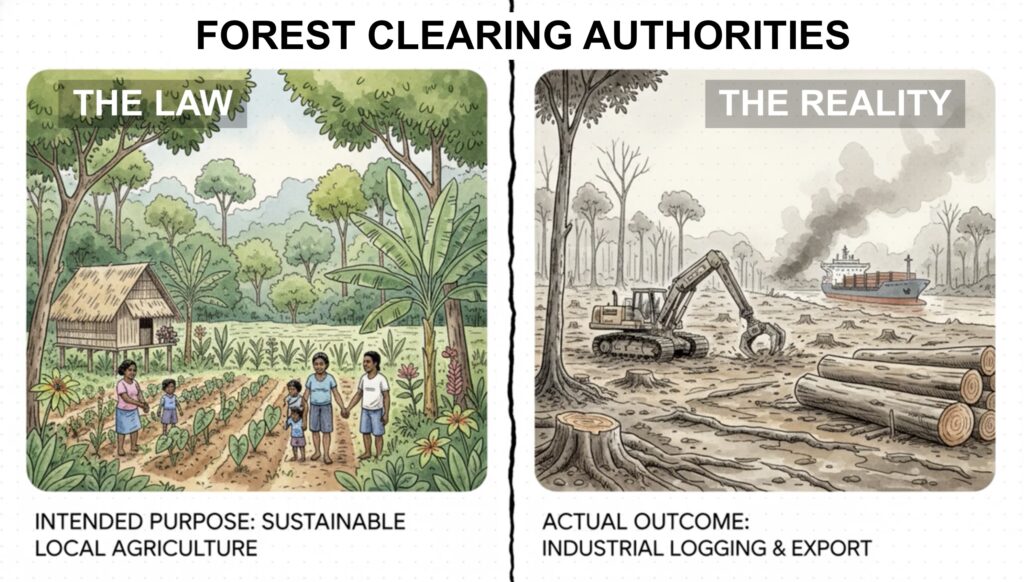
Image from www.actnowpng.org
FCA logging operations have also been associated with allegations of human rights abuses and environmental damage.
Such has been the controversy over the abuse of FCA licences, in November 2022 the National Forest Board placed a moratorium on issuing new FCA licences and ordered an audit of all existing projects. Despite the moratorium, FCA logging projects continue to provide around one-quarter of all log exports.
Two FCA projects operated by companies in the Joinland Group, Maxland Limited and Joinland (PNG), have attracted particular criticism as we explore below.
Pohowa FCA – Manus
According to Global Witness, Maxland’s purported rubber plantation on Manus Island “is a highly likely front for illegal logging” and it has described the operation as “a logging project apparently masquerading as a rubber plantation development that sowed false hope among an impoverished community – before dashing it completely”.
Global Witness says the FCA was issued by the National Forest Board against the advice of the Provincial Forest Management Committee and in breach of the Forestry Act.
Global Witness has also documented how proper resource owner identification and consent processes were bypassed and abused.
Global Witness claims local leaders were allegedly tempted by the company into supporting the project through gifts of new houses.
New Hanover FCA – New Ireland
Global Witness has documented how three agriculture leases were issued in 2007, covering almost 80% of the island of New Hanover. Logging was contracted to Joinland (PNG) Ltd.
Between 2012 and 2018 Joinland exported over 650,000 cubic metres of logs worth more than US$65 million from the island, but, according to Global Witness in 2020, no rubber had ever been exported.
According to officials, the rubber trees that were planted were of the wrong species, and according to local John Aini, the whole project was “chaos”.
“No one really cared if the rubber trees would grow; it was the logs they wanted.”
Instead of long-term incomes from agriculture local people have been left with a destroyed natural environment.
“Our river system can no longer support livelihoods – undrinkable, no fish life – it’s difficult to catch fish and our people, especially children, continue to develop ulcers and other illnesses due to the devastated river.”
According to Joinland, the picture is very different.
In a media statement in December 2020 the Group claimed the New Hanover project had generated over RM100 million (US$24 million) for local landowners and the PNG government, and the company had planted almost 4 million rubber, cocoa, coconut and Calophyllum trees, had constructed houses and community facilities including churches, classrooms and aid posts and supplied over 1,800 water tanks.
“Joinland has a long-term commitment to the sustainable socio-economic development of New Hanover and its residents. We are determined to maintain and even enhance our efforts in partnership with the Papua New Guinea government, New Hanover stakeholders and residents moving forward. We remain committed to sustainably developing the island and improving the lives of everyone on it.” Dato’ Sri Thomas
Joinland has not provided any further updates on the project since this statement in 2020.
Avoiding banking restictions
A recent court case in Singapore involving Hah Tiing Siu and his Singapore registered company Multi Galaxy Pte Ltd has revealed how he has managed to deflect questions from commercial banks about his logging operations in PNG by hiding his ownership by using his wife as a nominee shareholder.
On October 21st this year, the Singapore Hight Court ruled Mr Hah was the beneficial owner of a company called Multi Galaxy and that his wife, Pamela Ling held her shares in the company on trust for him.
The court also found that Ms Ling had wrongfully transferred 279,650 shares in the company to herself in December 2023 and her removal of Mr Hah as a director was invalid.
Multi Galaxy was originally set up under the name Joinland Group Pte. Ltd in 2009 with Mr Hah as the sole shareholder and director.
In 2012, Mr Hah says he transferred half his shares in the company to Ms Ling so she could get an employment pass to stay in Singapore long term. The couple had married in 2001 and she had moved to Singapore with the couple’s three children in 2008.
Although Mr Hah now held just 50% of the shares he says he retained full control of the company and the couple both understood he remained the 100 per cent beneficial owner.
In 2016, Mr Hah transferred his remaining shares to Ms Ling and stepped down as a director to distance himself from the firm.
This was done, according to Hah himself, because of concerns raised by Standard Chartered Bank about his businesses, including the logging operations in Papua New Guinea.
In 2019, Mr Hah took back public control of the company. His directorship was reinstated and the shares transferred back to him.
Then, in 2020, Mr Hah told the court he received a notice from OCBC bank that the company bank account would be closed because of environmental and sustainability concerns about his interests in the timber industry.
This was at the same time that Global Witness published its report, Bending the Truth, that exposed Joinland’s alleged illegal logging project on Manus Island and publicly named Malaysian banks, including Maybank, CIMB and UOB, directly connected to the company.
In response to OCBC’s concerns, Mr Hah again transferred his shares to his wife and resigned as a director. It was now that Mr Hah also changed the name of the company to Multi Galaxy Pte LTD.
It appears these moves were sufficient to assuage the concerns raised by UOB as according to Multi Galaxy’s official business profile, the bank still holds a charge over the company’s assets.
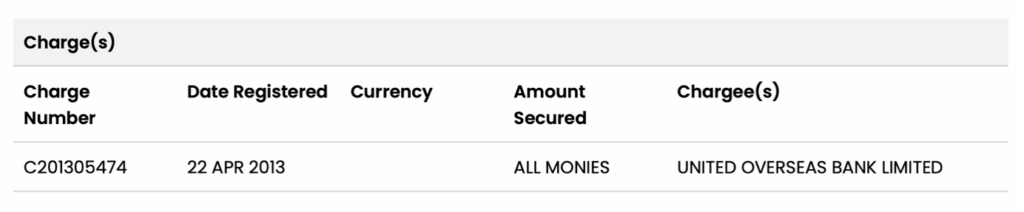
An excerpt from Multi Galaxy’s Corporate Profile showing United Overseas Bank Limited still holds a charge over the company’s assets
In 2023, Mr Hah decided to again take back public control of the company. In June 2023, Ms Ling signed documents transferring 279,650 shares (55.93% of the firm) to Mr Hah and reinstating him as a director.
Then, in December 2023, Ms Ling purported to transfer the shares back to herself and removed Mr Hah as a director. This was done after she filed for divorce in Singapore in August 2023.
In January 2024, Mr Hah made a police complaint about this transfer by Ms Ling, alleging it was fraudulent.
Then, in October 2024, Ms Ling filed a lawsuit in Singapore alleging her signature had been forged when the shares in Multi Galaxy were transferred to Mr Hah in 2023. Mr Hah counterclaimed, accusing his wife of wrongfully seizing control of the company.
The Singapore High court has now ruled that Ms Ling wrongfully transferred the shares in Multi Galaxy to herself in December 2023 and her removal of Mr Hah as a director was invalid.
It is against this backdrop that on April 9, 2025, Ms Ling disappeared while on her way to give evidence to the Malaysian Anti-Corruption Commission in relation to an investigation involving her and her husband. Mr Hah has been arrested and questioned in connection with the disappearance of his estranged wife.
Other overseas investments
The Joinland Group website provides brief details of various business and property investments in Malaysia, China, Singapore, Australia and New Zealand.
Not all of the information seems to be current.
For example, the Kiwitown Bakery in New Zealand is described as a food retailing chain that produces a wide range of fresh daily bakery, pastry, food and fried chicken. The business ‘aims to be one of the most popular across Asia Pacific with 40 retails within three years’.
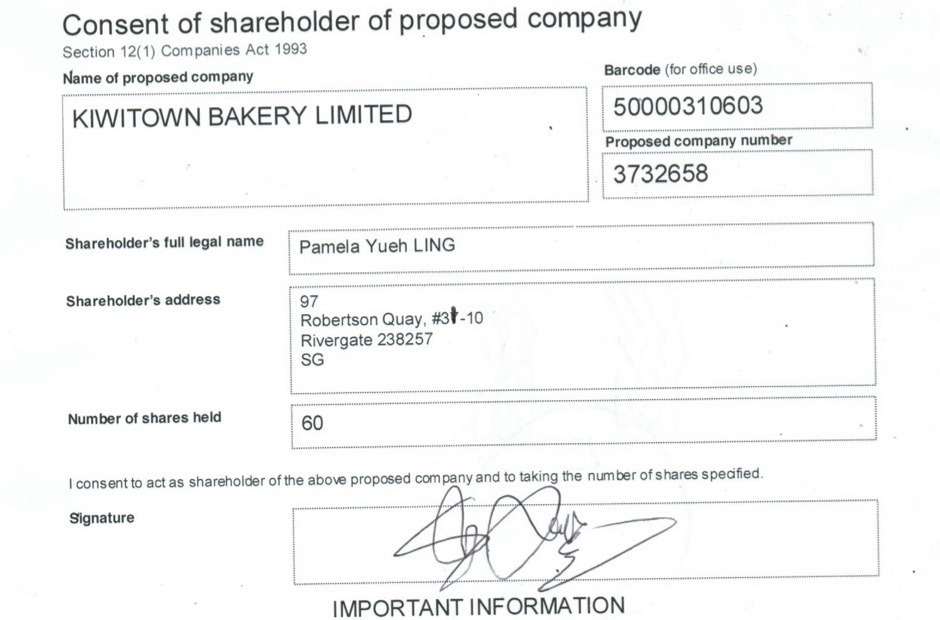
Pamela Ling’s signature as shareholder in the Kiwitown Bakery
It all sounds very promising, except according to the New Zealand Companies Office, the business was removed from the register in June 2016 and no longer exists.
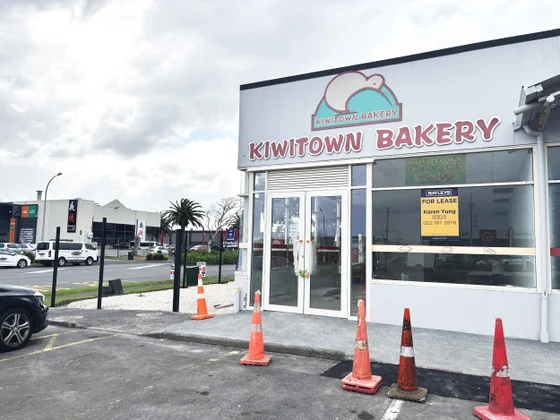
The shuttered premises of the Kiwitown Bakery in Auckland, New Zealand
Meanwhile in Australia, according to its website Joinland has already developed a piece of residential land on the Maroondah Highway outside Melbourne with a vision of a self-contained higher density residential area with town houses and apartments and facilities such as swimming pools, gyms and landscaped areas.
In truth it appears Joinland Properties Pty Ltd is a $1 company that owns a bare piece of land less than 6ha in size. Earlier this year the land was being advertised for sale as an ‘industrial zoned greenfield site’.
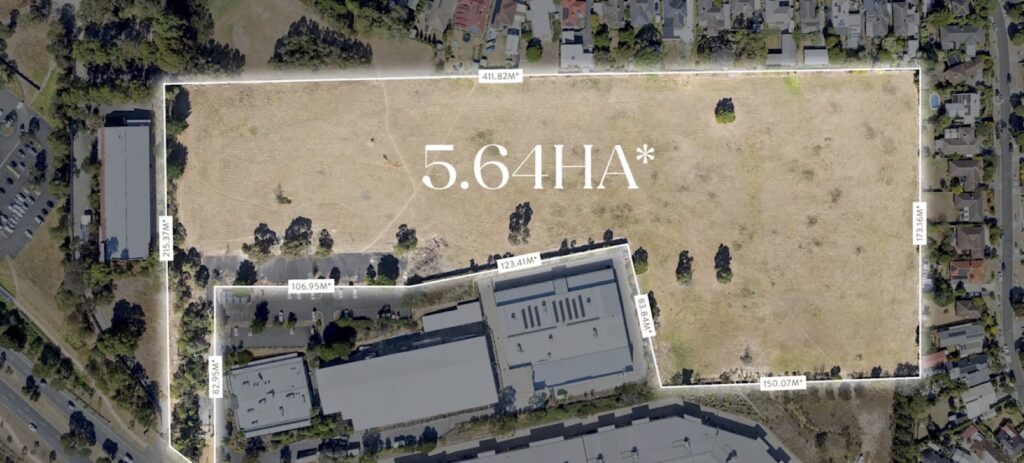
Ariel view of the bare plot of land at 270 Maroondah Highway, Chirnside Park in Melbourne, Australia